Outdoor solution guide
Yard Drainage Solutions for Augusta Homes
HomeGuide lists buried downspout systems at $150 to $350 per downspout. Check the roof route before pricing anything that requires a trench.
Editorial review: July 19, 2026. Cost figures and local guidance were rechecked on that date.
Augusta Yard Drainage Help is an independent educational service that helps connect homeowners with local outdoor drainage providers. It does not perform drainage or contractor work directly. Requests may be shared with a local outdoor drainage provider when a fit is available.
Quick answer
Use five patterns to narrow the choice: roof discharge calls for a solid route, wide sheet flow points toward grading or a swale, one repeatable low pool may fit a basin, a lingering wet strip may fit a French drain, and a site without gravity fall needs a separate storage or pumping review.
Sort the yard into five water behaviors
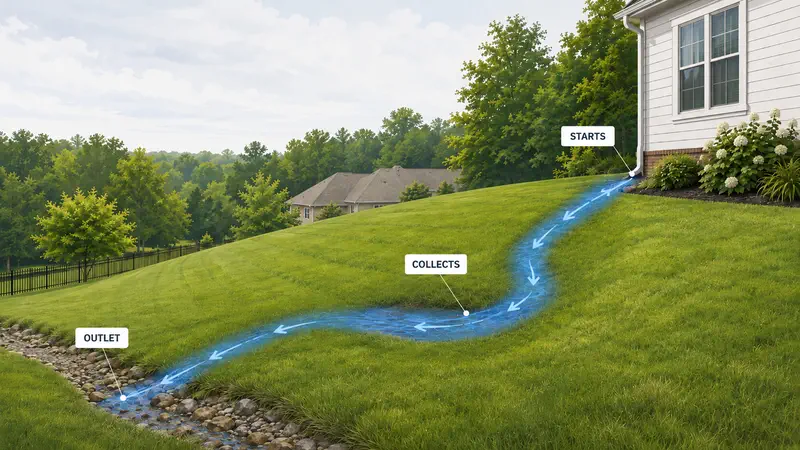
Identify the first visible source, the route across or through the yard, the place where water gathers, and the possible destination. Then classify the dominant behavior before comparing materials.
- A gutter outlet feeds the wet area as rain falls: begin with roof-runoff routing
- Water spreads over a wide surface: measure the grade and compare a shallow swale
- Runoff repeatedly reaches one low point: evaluate a surface inlet with solid outlet pipe
- A narrow band stays soft after surface water leaves: investigate subsurface collection
- Every gravity route rises before reaching a responsible destination: evaluate storage or pumping assumptions
Let the fall-line soil profile change the shortlist
On Augusta’s clay-side properties, slow infiltration can make a persistent saturated corridor a stronger collection candidate after roof and surface causes are controlled. Sandy-side ground can still fail when compaction, hardpan, or an interbedded clay lens blocks downward movement. A soil label alone never selects the drain; observed timing and a reachable outlet complete the decision.
Sources: New Georgia Encyclopedia fall-line soil transition · USGS Augusta-area interbedded clay findings
Price the roof route before wider excavation
The certified national planning figure for a buried downspout system is $150 to $350 per downspout. A visible extension can be simpler when it reaches a stable destination without crossing a walkway or mowing path. Buried work adds the route, fittings, utility conflicts, outlet, and restoration to the decision.
Use the roof-water inspection and routing choices →
Sources: HomeGuide drainage-system costs
Use surface shape for wide runoff
Grading changes elevations, while a broad swale gives surface water a shallow maintained path. This lane fits sheet flow and reverse slope. The certified cost set contains no standalone grading or swale range, so compare measurement, soil movement, compaction, stabilization, outlet work, and restoration as one scope.
Review Augusta grading measurements and swale construction →
Put a basin only where runoff can reach it
A catch basin accepts surface water at a defined low elevation and sends it through solid pipe. The grate cannot collect water trapped behind a hump, and an inlet with no lower outlet merely stores the problem underground. Quote the inlet, pipe, discharge, access, and lawn repair together because the approved source set gives no basin-only figure.
Reserve French-drain cost for a subsurface job
For shallow exterior yard and curtain French drains, HomeGuide’s national planning band begins at $10 and reaches $35 per linear foot. More involved exterior projects run from $10 to $65 per linear foot in the Modernize and LawnStarter guides. Those figures earn a place only after the evidence supports a wet subsurface path and the design has an outlet.
See the Augusta French-drain method and outlet sequence →
Sources: HomeGuide French-drain costs · Modernize French-drain costs · LawnStarter French-drain costs
Treat a missing gravity outlet as its own problem
Storage relies on the soil accepting water and on a safe overflow path. Pumping adds equipment and a higher discharge route. Modernize lists $500 to $4,000 for sump systems, while Lawn Love lists a $625 to $2,625 French-drain pump add-on. Neither number settles whether the destination is permitted or workable.
Sources: Modernize pump-system range · Lawn Love French-drain add-on range
Confirm the destination before calling the plan complete
Augusta Engineering manages municipal stormwater facilities and the county code addresses private systems that discharge to the public system. Confirm ownership and requirements before assuming that a ditch, inlet, right-of-way, or public pipe can receive private runoff. Keep concentrated water off neighboring property and protect the release point from erosion.
Sources: Augusta Engineering stormwater program · Augusta-Richmond County stormwater code
Common questions
Which Augusta yard drainage fix should I compare first?
Start with the visible source and the least disruptive method that controls it. A roof-fed wet area puts the downspout route ahead of broad excavation.
When does a catch basin make sense?
It fits a repeatable surface low point when nearby grade carries runoff to the grate and solid pipe can reach a responsible lower outlet.
When should a French drain enter the decision?
Evaluate one for a recurring saturated strip or seep after roof discharge and broad surface flow have been separated from the diagnosis.
Does sandy Augusta soil rule out drainage problems?
No. Compaction, hardpan, restrictive clay lenses, grading, and seasonal saturation can keep sandy-side ground wet. The observed profile matters more than the regional label.
Can one property need several drainage methods?
Yes. A roof route, surface inlet, swale, and subsurface collector can have separate jobs, but their combined discharge still needs one coherent plan.
Send your drainage details
Describe where the water begins, how it moves, where it collects, and how long it remains after rain.
Your request may be shared with a local outdoor drainage provider for follow-up. Submission does not guarantee availability, price, timing, or results.