French drain method guide
French Drain Installation Help in Augusta, GA
NDS recommends a minimum 1% slope for positive drainage on its French-drain system. That target only works when the outlet elevation is established first and every section of the collector can fall toward it.
Editorial review: July 19, 2026. Cost figures and local guidance were rechecked on that date.
Augusta Yard Drainage Help is an independent educational service that helps connect homeowners with local outdoor drainage providers. It does not perform drainage or contractor work directly. Requests may be shared with a local outdoor drainage provider when a fit is available.
Quick answer
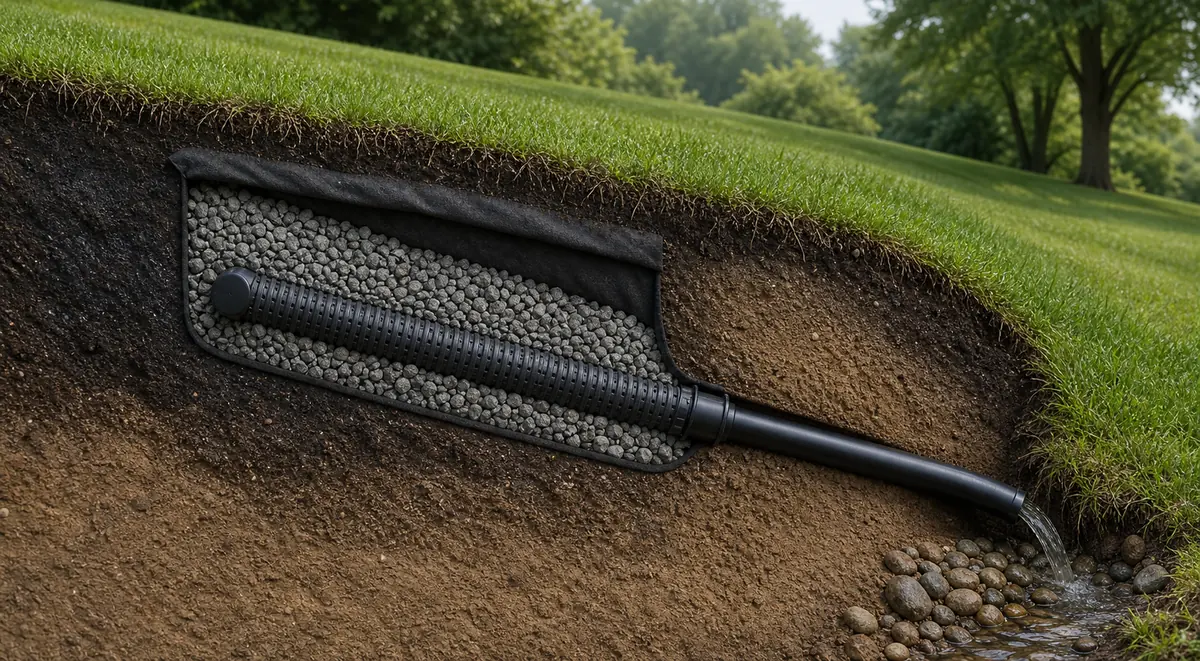
An outdoor French drain collects water moving through saturated soil with perforated pipe, open washed aggregate, and a separating fabric where the soil requires it. The collection run then needs a maintained gravity, infiltration, or pumped destination. Roof runoff and broad surface flow belong in other lanes.
Know the four working parts
The trench intercepts the wet path. Washed aggregate leaves voids for water to reach the collector. Filter fabric limits soil migration into those voids. Perforated pipe receives the water, while solid pipe can carry it after collection ends. Cleanouts and an accessible outlet keep later inspection possible.
Sources: NDS French-drain installation guide
Set the outlet elevation before the trench line
Start at the intended release point and carry grade uphill through the proposed route. NDS recommends at least a 1% positive-drainage slope for its EZflow system. Use that as a product-backed target, then verify the selected pipe instructions, the actual elevations, and any local discharge limits. A low pocket can retain sediment and water even when the endpoints appear correct.
Sources: NDS EZflow slope and clay guidance
Build in ten controlled steps
A sequence keeps utility clearance, grade, filtration, and restoration tied together.
- Confirm the collection problem and the responsible discharge point
- Submit the Georgia 811 ticket when mechanized excavation is planned
- Review member responses and locate private irrigation, septic, lighting, and owner-installed lines
- Stake the outlet, trench route, transitions, and cleanout locations
- Excavate while checking the trench bottom for uninterrupted fall
- Place the specified fabric and a washed-aggregate bedding layer
- Set the perforated collector according to its product orientation instructions
- Transition to solid carrying pipe after the collection zone when the design calls for it
- Surround the collector with washed aggregate and close the filtration layer
- Stabilize the outlet, backfill, restore disturbed surfaces, and leave maintenance points accessible
Sources: NDS French-drain sequence · Georgia 811 excavation process
Change filtration assumptions across Augusta soils
Clay-side soil can release fine particles into open stone, so fabric selection and a complete separation layer deserve explicit attention. Sandy-side soil may move water quickly until a compacted horizon or interbedded clay lens interrupts it. Place the collector to intercept the observed wet path; a generic depth can miss the restrictive layer or bury the pipe below usable gravity fall.
Sources: UGA Piedmont soil and infiltration guidance · USGS Augusta-area clay-lens findings
Make excavation compliance part of the route
Under Georgia’s utility-protection law, mechanized trenching requires notice. Georgia 811 says to submit at least three business days before digging and to check utility responses before work begins. Member marking covers public facilities; the excavator still needs a plan for privately owned lines that can force hand work, rerouting, or a different depth.
Sources: Georgia Public Service Commission excavation law summary · Georgia 811 ticket timing and response check · Georgia 811 private-line guidance
Use the published costs as planning boundaries
HomeGuide’s national shallow-exterior band begins at $10 and reaches $35 per linear foot for yard and curtain French drains. For difficult exterior construction, the Modernize and LawnStarter guides span $10 to $65 per linear foot. Depth, access, soil handling, aggregate, transitions, outlet construction, and lawn or hardscape repair decide where a complete Augusta scope lands.
Compare complete Augusta drainage estimate factors →
Sources: HomeGuide French-drain costs · Modernize French-drain costs · LawnStarter French-drain costs
Reject the method when the water stays above ground
A French drain is a poor first response to one overflowing downspout, wide sheet flow, or a surface bowl that never delivers water into the trench. Those patterns keep feeding the yard while a subsurface collector performs a different job. Send source questions back to diagnosis and surface behavior back to the solutions hub.
Confirm discharge before buying pipe and stone
A daylight outlet must remain stable and open. Infiltration storage needs soil acceptance and overflow planning. Pumping needs power, maintenance, and a valid release point. Confirm with Augusta before connecting to or materially affecting a public stormwater feature.
Sources: Augusta Engineering stormwater program · Augusta-Richmond County stormwater code
Common questions
How much fall does an Augusta French drain need?
NDS recommends a minimum 1% slope for positive drainage on its EZflow system. The actual route must verify continuous fall to a workable outlet and follow the selected product instructions.
Why does clay-side soil need careful filtration?
Fine clay particles can migrate into the aggregate voids that feed the collector. A suitable fabric layer separates soil from washed stone while preserving the intended water path.
Can sandy-side ground still need a French drain?
Yes. Compaction, hardpan, or an interbedded clay lens can hold water above a sandy layer. The collector depth should follow the observed restrictive profile and available outlet grade.
What does a French drain cost?
National planning sources publish $10 to $35 per linear foot for shallow exterior work and up to $10 to $65 per linear foot for more complex exterior projects. Augusta quotes depend on the complete route and restoration.
When is a French drain the wrong fit?
Use roof-water routing for a downspout source and grading or a swale for broad surface flow. A French drain earns its role when the evidence supports water moving through a repeatable saturated-soil path.
Send your drainage details
Describe where the water begins, how it moves, where it collects, and how long it remains after rain.
Your request may be shared with a local outdoor drainage provider for follow-up. Submission does not guarantee availability, price, timing, or results.